

Program

The development of the country requires a long-term strategy based on technology, science, innovation, and entrepreneurship to achieve a shift in the productive matrix. The PhD Program in Engineering Sciences with a specialization in Bioprocesses at the University of La Frontera was established in 2015 to contribute to the scientific and technological development in the field of bioprocesses in our country.

The Program aims to contribute to education in engineering sciences, technological development, and its subsequent transfer. The academic staff has a high level of scientific productivity, both in terms of securing research projects and generating scientific publications. Additionally, the faculty members participate in the Scientific and Technological Center for Bioresources (BIOREN-UFRO), which aims to strengthen multidisciplinary R&D in biological resources and bioprocesses associated with food production, environmental sustainability, and human health.
The PhD in Engineering Sciences with a specialization in Bioprocesses at the University of La Frontera aims to train researchers capable of proposing and conducting original and relevant research independently, collaboratively, and ethically in areas such as environmental and food bioprocesses, contributing to knowledge advancement.

Applicants must hold a Bachelor’s or Master’s degree in Science in fields compatible with the Program (Food Engineering, Environmental Engineering, Chemical Engineering, Biochemical Engineering, Biotechnology Engineering, Bioprocess Engineering, or similar fields), or possess a professional degree with equivalent studies. Further information and required documentation will be specified in each application call.

Graduates of the PhD Program in Engineering Sciences with a specialization in Bioprocesses will have a comprehensive vision and solid training in engineering sciences, with an emphasis on environmental or food bioprocesses. They will be capable of conducting original research that generates frontier knowledge in the declared research areas of the Program, proposing innovative solutions in environmental or food bioprocesses, and effectively communicating research results in scientific dissemination media. They will be able to work with others autonomously, responsibly, and ethically. Graduates can work in R&D units, both public and private, as well as in higher education centers.

Study Plan

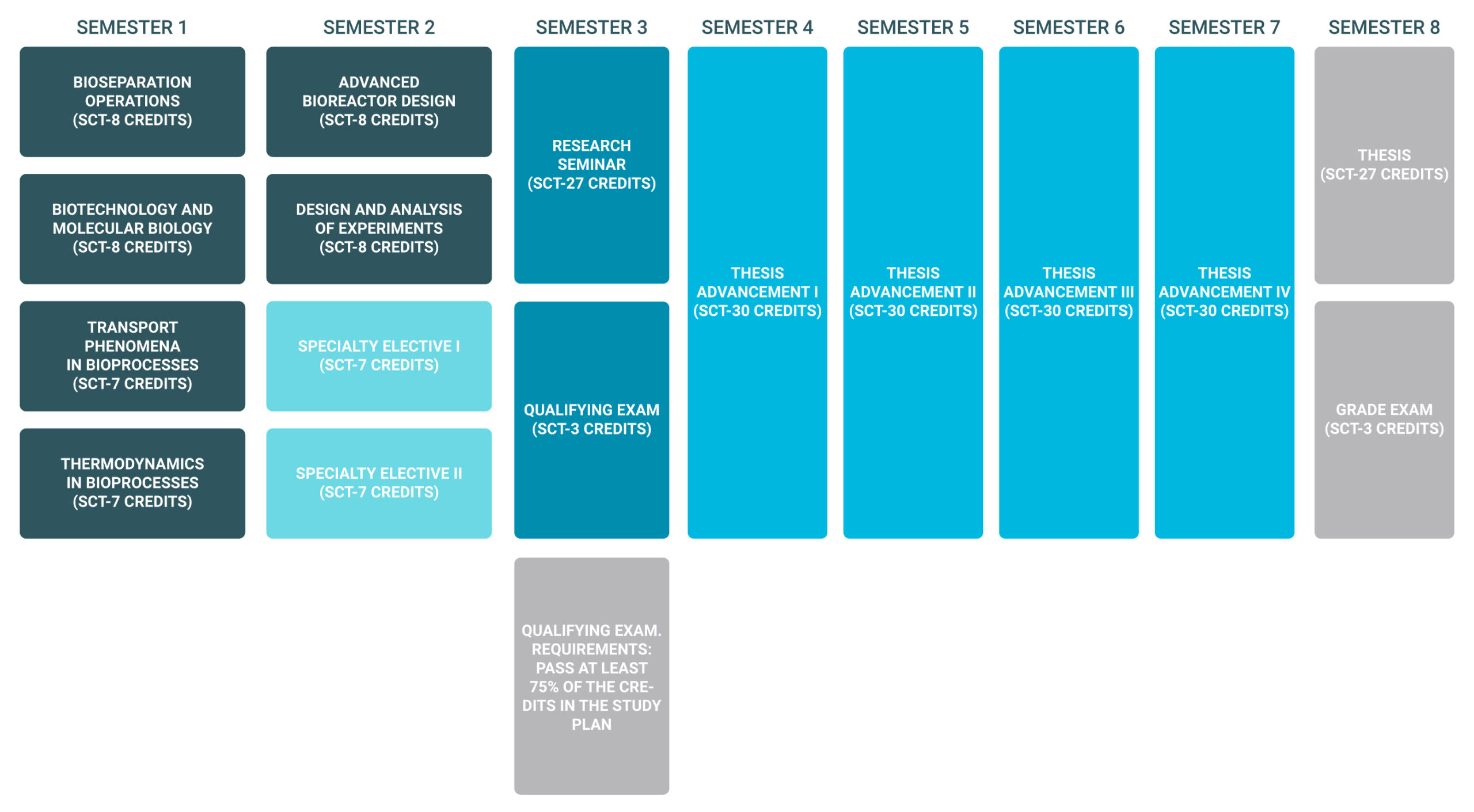
The Program is academic in nature and requires full-time dedication. The Study Plan includes a total of 240 transferable credits distributed over 8 academic semesters (30 credits per semester). It includes 8 courses, a Research Seminar, a Qualification Exam, and the Doctoral Thesis. The Thesis formally begins after passing the Qualification Exam. To defend their thesis, candidates must generate at least two publications. One must be published (or formally accepted), and the other must be submitted to a scientific journal listed in the Journal Citation Reports database. The Thesis must be defended in a public exam before the Examination Committee defined by the Academic Committee. The Program is managed by a Director, assisted by the Program’s Academic Committee, as established in the General Regulations for Doctoral Programs.